Mother
The Character of RainMother is the narrator’s first caregiver and one of the adults who must make sense of a child who does not cry, move, or develop as expected. She seeks medical help, changes how she feeds the child when breastfeeding fails, and tries to interpret the child’s anger and behavior. Her care is practical but shaped by the same developmental assumptions that lead the adults around her to mistake the child’s refusal for a blockage. Later, she has to explain that the family will leave Japan and that Nishio-san cannot come with them; after the child is rescued, she is among the first family members to see the crisis and calls for hospital care.
Care in the Face of an Unresponsive Infant
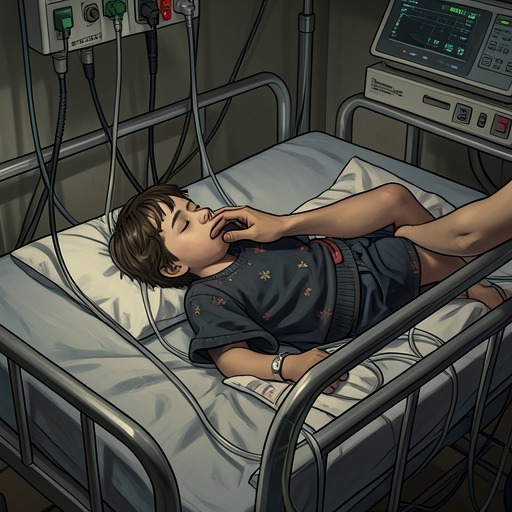
Mother and Father are deeply concerned by the infant’s stillness and bring specialists to examine the child. The doctors find no reflexive response when they test the child’s knees and elbows, and no movement of the pupils under a light. The parents report that the child never cries, moves, or makes a sound. When the specialists call the condition pathological apathy and recommend hospitalization, the parents are relieved by the diagnosis that the child is still alive, even if described as a vegetable. They disregard the hospital advice: their two older children are already full members of the human race, and they find that having a third child in this condition still awakens tender feelings. They affectionately call the child the Plant.
Feeding presents Mother with a more immediate problem. She tries to breastfeed, but the baby does not instinctively move toward her breast. Mother places the infant nose to nose with it, then, concerned and irritated, forces her nipple into the child’s mouth. The child barely sucks, if at all, so she switches to a bottle. The bottle works: its cylindrical form suits the child, who takes to it immediately despite showing no comparable attachment to the roundness of the breast. Mother feeds the child several times a day, unaware that this practical solution reinforces the child’s affinity for tubes. The episode makes care concrete and bodily, while the narrator’s account gives that routine a larger meaning: nourishment itself becomes an encounter between one tube and another.
Adult Explanations and the Child’s Difference
By the age of two, the child still has not tried to crawl or made a sound. Mother, Father, the doctors, and the nanny interpret this as some kind of developmental blockage. Their explanation assumes that the child’s condition must be physical; the possibility that the child might prefer remaining inert does not occur to them. Mother later offers her own account of the child’s anger: she thinks the child recognizes that development is late and becomes upset as a result.
The narrator rejects that interpretation. The child does not understand itself as behind, since that would require submitting to comparison with other children. Instead, the child senses great power but cannot exercise it, and experiences the mouth as the obstacle: its lips cannot produce language. Mother’s explanation thus reveals the gap between an adult’s effort to locate the behavior within a familiar developmental timetable and the child’s account of frustration as a conflict between felt capacity and bodily limitation. Her interpretation is mistaken in the narrator’s telling, but it also shows her trying to give meaning to behavior that the specialists’ diagnosis has not explained.
Family Boundaries and Separation
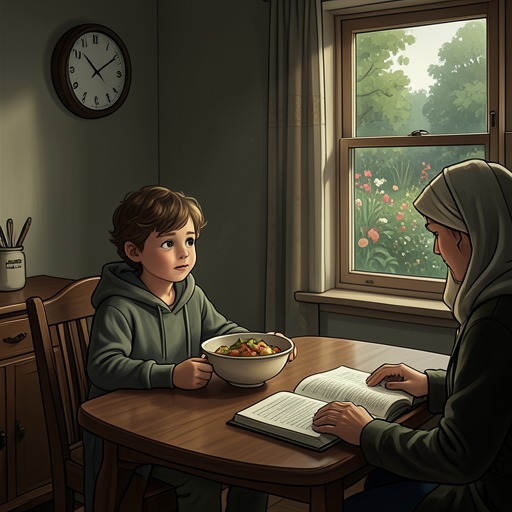
Mother’s relationship with the child is also shaped by the presence of Nishio-san, whose affection and indulgence give the child a powerful bond beyond the immediate family. When the child takes food from Nishio-san’s plate, Mother sees the behavior and scolds Nishio-san, asking her not to let herself be tyrannized. As soon as Mother turns away, the child resumes eating from the plate. The episode exposes a small domestic conflict: Mother tries to set a limit, while the child’s preference for Nishio-san’s okonomiyaki and seasoned rice makes the indulgence hard to resist.
That attachment becomes painful when Mother explains that the family will eventually leave Japan. The child is sobbing in her arms and repeating that Nishio-san has to stay. Mother gently says that the separation will happen regardless: Father will not remain in Japan forever, and in a year, two years, or three, the family will leave without Nishio-san. She suggests that perhaps this is a good time for the change. To Mother, the explanation is an attempt to prepare the child for an inevitable departure; to the child, the news arrives as a collapse of the known universe. The mismatch in scale is central to the scene: Mother speaks in the measured terms of a future move, while the child experiences the loss as an immediate catastrophe.
Response to the Child’s Crisis
After Nishio-san pulls the child from the water, she runs into the house carrying the child and finds Mother. Mother takes one look and screams. The response joins her to Nishio-san’s alarm, but the two women have different roles in the rescue: Nishio-san has seized and revived the child, while Mother receives them inside the house and calls for medical help. The announcement that they are going to Kobe Hospital turns the return to life into an urgent family response rather than a private recovery.
Across these episodes, Mother’s care moves between seeking explanations, managing ordinary needs, and confronting events she cannot control. The story does not present her as understanding the child’s inner life; her account of the child’s anger is explicitly challenged, and her attempt to prepare the child for separation cannot prevent its devastation. Yet she keeps responding: she brings the infant to specialists, finds a workable way to feed the child, holds the sobbing child through the news of departure, and acts when the rescued child is brought to her. Her significance lies in that continuing, imperfect care, set against the child’s resistance to the developmental and family arrangements adults take for granted.